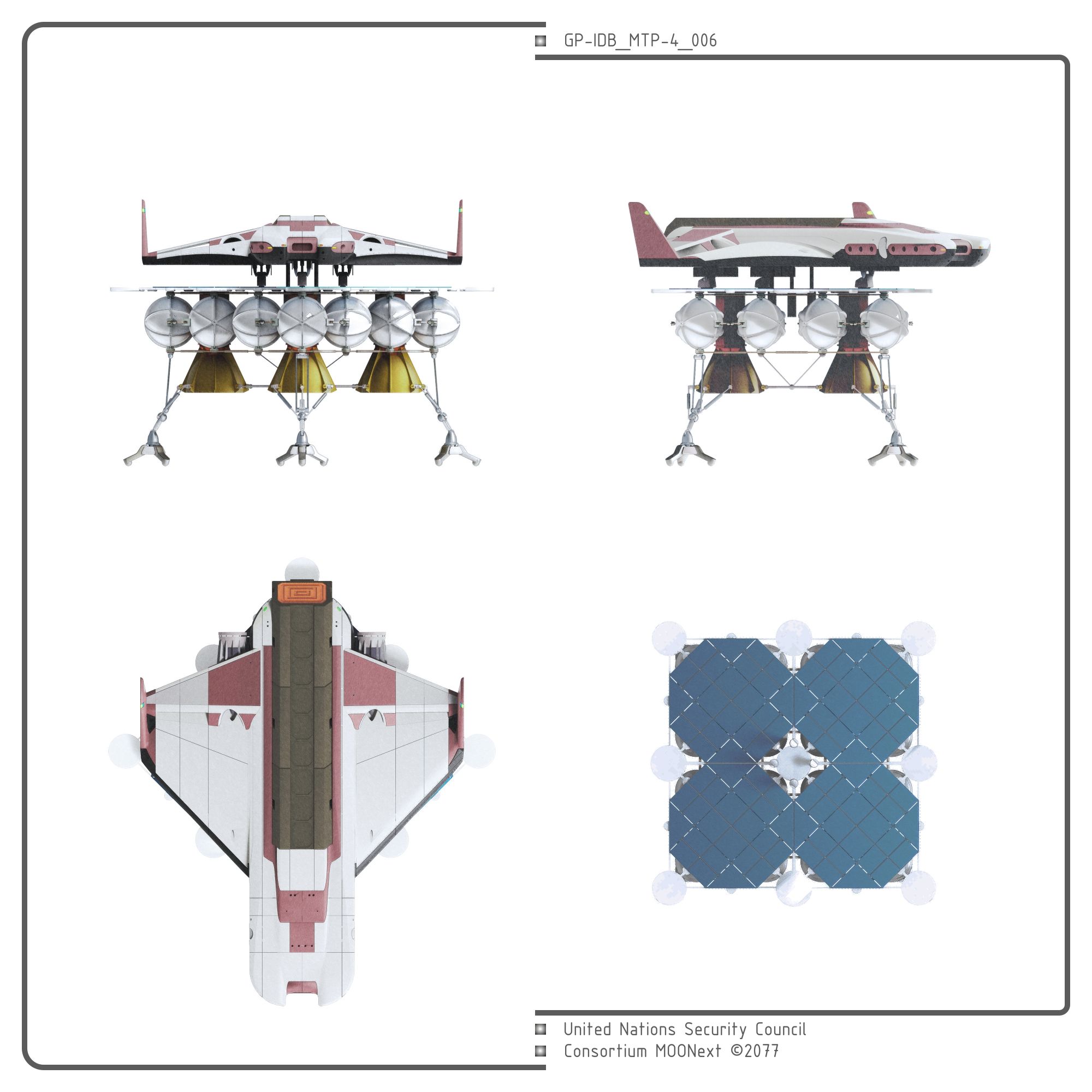
Moon Transport Platform
Property
Copyright: Consortium MOONext / © 01/01/2077
History
The modular platform system in lunar orbit allowed considerable fuel savings on the journeys to Earth in the late 21st century. They remain refueled in stationary orbit, waiting for the Copernicus shuttles to arrive and land at any of the satellite’s ports.
The Falkon robots currently perform take-offs and moon landings almost daily, given the increase in industrial traffic generated from the Luna-3 and Luna-4 factories.
The moon’s fuel began to be synthesized at the Luna-1 factory, inaugurated at the end of the 2070s. At these facilities, solar electrolysis of hydrogen and oxygen from the Moon’s ice generates sufficient supplies for all the Copernicus return flights to Earth.
Characteristics
CAPACITY: 1 STS-65 shuttle
PAYLOAD: 3 STU (Space Transport Unit) containers of 250 m3
POWER SOURCE: Propergol of Hydrogen + Oxygen / Photovoltaic
ECOENERGETIC RATIO: 0.635
DIMENSIONS: 48,000 x 48,000 x 21,500 mm